

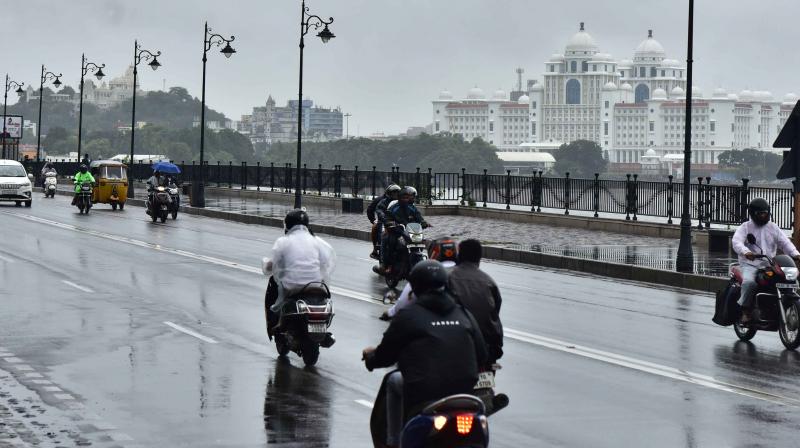
Once known for its lakes and natural drainage channels, Hyderabad is today struggling with frequent waterlogging and flash floods as rapid urban growth, loss of open spaces and uneven rainfall put heavy pressure on ageing stormwater systems.
Last year, the opening of gates at Osman Sagar and Himayat Sagar, increased flow in the Musi River led to flooding in several low-lying areas, exposing how vulnerable the city has become during heavy rains. Short, intense downpours now burst drainage networks, turning main roads into streams and residential colonies into temporary water pools. As extreme rain events become more common, stormwater management has emerged as one of Hyderabad’s most pressing urban challenges.
Experts say the solution lies in more than just building wider drains. Hyderabad needs decentralised, source-level water management, where rainwater is captured, stored and reused before it reaches main drains. Measures such as rainwater harvesting, green open spaces, local water retention systems and improved rainfall forecasting can reduce flood pressure on central infrastructure. For a fast-growing city, strengthening urban water resilience is no longer a choice, it is essential to protect daily life, property and the city’s long-term future.
To better understand and address these challenges, the Indian Green Building Council (IGBC), in collaboration with the Greater Hyderabad Municipal Corporation (GHMC), hosted a consultation on urban water management on Thursday amid rising flood risks.
Addressing the meet, R. V. Karnan, Commissioner, GHMC, said the city is dealing with stormwater, sewerage and water supply together to reduce urban flooding. He said GHMC is mapping how water enters, flows through and exits the city, while strengthening stormwater drains and nalas. Stressing that centralised systems alone are not enough, he called for decentralised water management, a greater role for Resident Welfare Associations
(RWAs), use of real-time weather data, and partnerships with industry and private players to focus on retention, reuse and pollution reduction at source.

Ashok Reddy, Managing Director, Hyderabad Metropolitan Water Supply and Sewerage Board (HMWSSB), said the board is prepared to meet the water needs of Hyderabad and the nearly 2,000 sq km Core Urban Area. He highlighted Musi River rejuvenation, use of Godavari-linked Osman Sagar and Himayat Sagar, steps to address falling groundwater levels, standardised rainwater harvesting pits, operation of 43 STPs, and the growing use of treated grey water by data centres, while outlining a vision for a water-secure Hyderabad by 2030.
Meanwhile, Anurag Jayanti, Additional Commissioner, GHMC, stressed the need for climate-resilient stormwater governance, calling for decentralised water retention across neighbourhoods and open spaces, supported by data-driven planning.
C. Shekar Reddy, National Vice Chairman, CII IGBC, noted that urban water management is a major challenge for growing cities and stressed the need for practical, scalable solutions through policy–industry collaboration.
Srinivasa Murthy G, Chairperson, IGBC Hyderabad Chapter, said Hyderabad’s stormwater and wastewater planning will be critical for flood risk reduction and long-term livability, with water-sensitive design and green practices playing a central role.
Got questions or experiences to share? Comment below or connect with me on Instagram @samuelmjosh and LinkedIn: https://www.linkedin.com/in/samuel-joshua-maddela-ab210b1b9


