

Public perceptions of politics are gradually changing as more young Indians look beyond election campaigns and focus on governance, public policy and the leaders shaping everyday life. The rise of youth-led movements such as the Cockroach Janata Party, alongside the growing influence of social media, reflects how Gen Z is engaging with politics differently, asking tougher questions, joining public conversations and taking a greater interest in the decisions that shape their future.
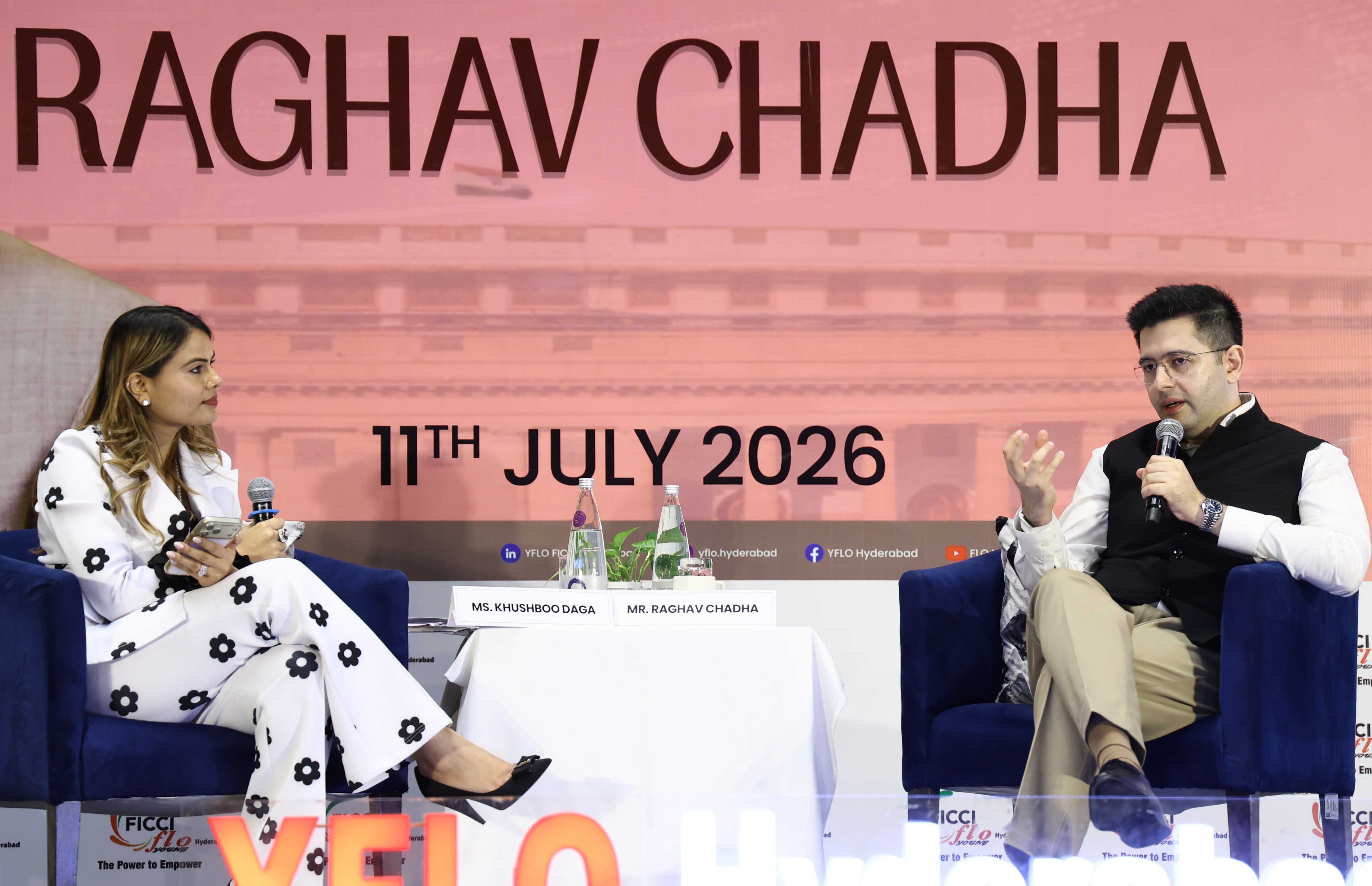
“In the past, nations that controlled oil emerged as global powers. Today, that power is shifting towards Artificial Intelligence. Countries that control AI technologies will shape the future,” said Raghav Chadha, Rajya Sabha MP. Speaking candidly during an interactive session in Hyderabad, Chadha reflected on his unexpected journey into politics, why young people hesitate to see politics as a career, the global race for Artificial Intelligence, and the role of social media in reshaping political communication.
Chadha had the audience laughing as he recounted the unexpected path that brought him into politics. “Chartered Accountancy is far more difficult than winning elections. I say this because I was trained to be a Chartered Accountant, but politics just happened. I did not choose politics; politics chose me,” he remarked.
Coming from a non-political family, Chadha said politics was never part of his original plan. “None of my family members had ever been involved in politics, nor has anyone fought a panchayat election. I never planned to enter politics. I was drawn to the Anti-Corruption movement in 2010-2011. I attended one event, and one thing led to another, and I finally entered political life. That journey eventually brought me here,” he said.
Raghav Chadha was speaking during a panel discussion titled “Indian Politics Redefined”, hosted by the Young FICCI Ladies Organisation (YFLO) Hyderabad Chapter under the leadership of Chairperson Khushboo Daga.
Turning to the global race for Artificial Intelligence, Chadha said the balance of geopolitical power is changing, with nations leading AI innovation set to shape the future. He explained that AI systems rely heavily on advanced Graphics Processing Units (GPUs) for training and inference. “The world’s most advanced AI chips are predominantly designed by NVIDIA in the United States, while a majority of these cutting-edge chips are manufactured by Taiwan-based TSMC. This highlights how a small number of companies play a critical role in powering the global AI revolution,” he said.
Shifting the focus to the digital age, Chadha said social media has fundamentally transformed political communication. “Messaging is about creating a narrative, while social media is about amplifying it. Earlier, a message would take 24 hours to reach people. Today, it can travel across the country in just 24 seconds,” he observed.
For Chadha, India’s demographic strength should also be reflected in its political leadership. “India is one of the youngest countries in the world. Nearly 65 percent of our population is below the age of 35, and the average age of an Indian is around 28 years. We need more young participation in politics too. Politics needs young blood, along with the wisdom of seasoned politicians. I urge young people to consider playing a role in mainstream politics,” he said.
Despite that, he believes politics remains an unlikely career choice for most young Indians. “In India, many young people aspire to become doctors, engineers, pilots, scientists, actors etc. No one grows up saying they want to become a politician,” he observed.
In Parliament, Chadha said his focus has remained on issues that touch everyday lives. “We get very limited time in Parliament to raise issues. I make every minute count by speaking about problems that affect everyday Indians and issues that often go unnoticed. I have raised concerns relating to consumer rights, airport pricing, gig workers’ welfare and several other matters that directly impact citizens,” he said.
Chadha added that several of those interventions have gone on to shape broader policy discussions, including affordable airport services and GST simplification.
As India’s youth begin to take an interest in governance and politics, many will be watching whether political leaders who call for greater youth participation can translate those ideas into meaningful policy and lasting change, enabling more young people to come forward and raise their voices.
Got questions or experiences to share? Comment below or connect with me on Instagram @samuelmjosh and LinkedIn: https://www.linkedin.com/in/samuel-joshua-maddela-ab210b1b9


